Gospel for Asia Responds to the Question: What is a Jesus Well Worth?
If someone were to ask what a Gospel for Asia Jesus Well is worth, the most popular response from faithful followers of our work might be “$1,400.” That’s because we consistently remind our family of believers that a gift of $1,400 can fund the building of a brand-new Jesus Well.
However, $1,400 is what it costs Gospel for Asia to install a well in drought-ridden villages across South Asia. The value of a Jesus Well is something entirely different.[1]
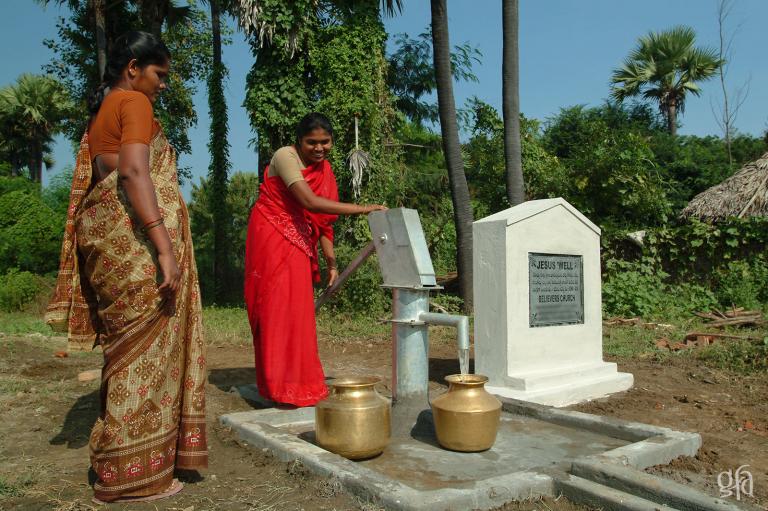
Defining the Value of a Jesus Well
Whether we realize it or not, we make nearly all of our purchases based on the value proposition of a business transaction. For example, if someone is buying a new tire for their car, their buying decision will take into account the expected length of time they intend to own the car. If they plan on trading the car in the near future, most people will choose to purchase a less expensive tire than they would if they were planning to keep the car for a long time. Price is an issue, but the amount the customer is willing to spend is primarily based on the value they expect to receive. Our point here is to try to establish the value of a Jesus Well.
Villages do not pay for installation or maintenance of Jesus Wells, so the value proposition is not based on cost at all. It is entirely about the benefit received. Christian businessman, Bill Westwood, explains biblical value proposition this way:
Christ’s work of salvation includes the potential for us to fulfill that mission of adding true value by collaborating with him in the process of bringing order out of chaos.
[The value proposition is] the combination of resulting experiences . . . which an organization delivers to a group . . . in some time frame.
Delivering value . . . , meeting their needs and, wherever possible, exceeding their expectations, is to fulfill the golden rule to “love your neighbor as yourself” (Matt 22:39). In serving and loving others, we are serving God inasmuch as humanity bears the imago Dei.[2]
So, defining the worth or value of a Jesus Well has to be ‘calculated’ in the eyes of the recipients.
The Need for Jesus Wells
Disease
“More than 1.8 million children under the age of five die each year from illness associated with contaminated drinking water. Primary diseases contracted from unclean drinking water include cholera, diarrhea, typhoid, roundworm, hepatitis, and dysentery.”[3]
“It is estimated that over 80% of India’s population does not have access to clean drinking water. Indians regularly drink water from lakes, ponds, and rivers. This is the same water used for bathing, laundry and watering cattle.”[4]
One child dies every 90 seconds due to waterborne disease.[5]
Poverty
Lack of readily available clean water is inextricably related to poverty.
“I don’t think people in the West can even begin to understand that there are people, like the Untouchables in India or Nepal, who have to walk eight, nine, or ten miles with a water pot to draw water from some pond. And often it’s a dirty pond because they are not allowed to draw water from the public well where the upper castes are also drawing water.”[6]
How can a person be productive and provide for their families if one or more of the people in the household has to spend several hours per day carrying pots to fetch water?
Education
When children are sick because of waterborne disease, they cannot attend school.
When children are needed to help carry water long distances, they cannot attend school.
Click here, to read more about this article.
Click here, to read more blogs on Patheos from Gospel for Asia.


Comments
Post a Comment