Saving Lives at Risk from Open Defecation (Part 2)
Wills Point, Texas – GFA Special Report (Gospel for Asia) – Discussing the troubling problem of open defecation and the lack of basic sanitation for millions throughout the world.
Talking Openly About Open Defecation
Another key dilemma in this discussion—open defecation, hardly a dinner-table topic or a mission committee agenda item—is the fact that accessibility to toilets does not always indicate usage. Changing habits is mostly a matter of changing mindsets in the face of the stranglehold of deeply entrenched beliefs.
Elizabeth Royte, in a comprehensive August 2017 National Geographic Magazine article, reports visiting Parameswaran Iyer, India’s secretary of drinking water and sanitation, in 2016. A hand-numbered sign on his wall tracks progress.
“You see that?” he asks. “One hundred thousand is the number of villages that are ODF today.” (ODF is the acronym for open defecation free).
Royte reports working the internal math: “Just 540,000 to go, I note; three years before Modi’s deadline.”
Other players, including the World Bank, the Bill and Melinda Gates Foundation (with $40 million dollars in prize money allocated toward innovative approaches to new toilet technologies), hundreds of concerned social entrepreneurs, engineers with altruistic motivations, East Asian water initiatives, and countless faith-based organizations are tackling the seemingly intractable worldwide dilemma of toilets, sanitation systems and sullied water.
What drives all this magnitude of interest, field research, consortiums and consultations on sanitation/water projects, awarding of grants and money prizes? Disease—plain and simple. Both waterborne and airborne.
“Some 1.5 million people die globally each year from polluted water diseases alone.”
Facing the Facts about Toilets, Open Defecation
Elizabeth Royte, who is a sanitation expert traveling widely and reporting extensively, summarizes that “Modi aims to build more than 100 million new toilets in rural areas alone by 2019.” But she notes that “deep-seated attitudes may present an even bigger barrier to improving sanitation than a lack of pipes and pits.”
That being said, let’s first look at the data regarding the state of toilets and open defecation in Asia. Then let’s examine what development organizations, sanitation technologies and mission groups, namely Gospel for Asia, are attempting in order to help Asia become ODF.
Starting with a global overview, key facts regarding sanitation highlighted by the World Health Organization are:
- 39% of the people who make up the world population use managed sanitation not serving other households, with systems in place to safely dispose or treat excreta (2015).
- 2.3 billion people worldwide still do not have basic sanitation facilities.
- 10% of the population is thought to consume food irrigated by wastewater
- 892 million people still defecate in the open.
- 280,000 deaths annually (estimated) are caused by sanitation deficient environments, which is linked to transmission of diseases such as cholera, diarrhea, dysentery, hepatitis A, typhoid, polio, intestinal worms, schistosomiasis, and trachoma.
Now, while Modi has emphasized improved sanitation, it’s worthwhile to note that India has been struggling with these issues even before winning independence from Great Britain in 1947. In fact, Gandhi insisted, “Sanitation is more important than temples.”
Now, however, due to population growth, a conundrum exists: While the percentage that practice open defecation has dropped substantively, birth rates are creating an environment where more people live in geographic locations where fecal exposure is increasing, not decreasing.
- Today, some 157 million urban dwellers—that would be 37 percent of the urban population—lack a safe and private toilet.
- Even sewers are no guarantors of healthiness:
- In the capitol city of Delhi, pipes are corroded; they ooze waste;
- nearly a third of the booming city isn’t connected to underground lines.
- Many latrines flush into open drains, and 4 percent—some 700,000—of this urban population still defecate outdoors.
- Only 56 percent of the sewers are safely managed.
- Flies carry disease from roadsides and open fields. Just one gram of feces can contain 100 million viruses, 1 million bacteria and 1,000 parasitic cysts. These can be absorbed through cuts in the flesh, the porous nature of skin itself, or by drinking unsafe water and eating contaminated foods.
- Health figures are consequently staggering.
- Some 315,000 children under the age of 5 die each year from diarrhea.
- The chronically distressed digestive system doesn’t absorb nutrients or medicines well.
- Underweight mothers give birth to underweight babies.
- Worldwide, stunting affects an estimated 165 million children under the age of 5.
- And all of the above and much, much more could be cured and eliminated by the installation and use of proper sanitation systems in slums, hamlets, rural villages and large cities across India.
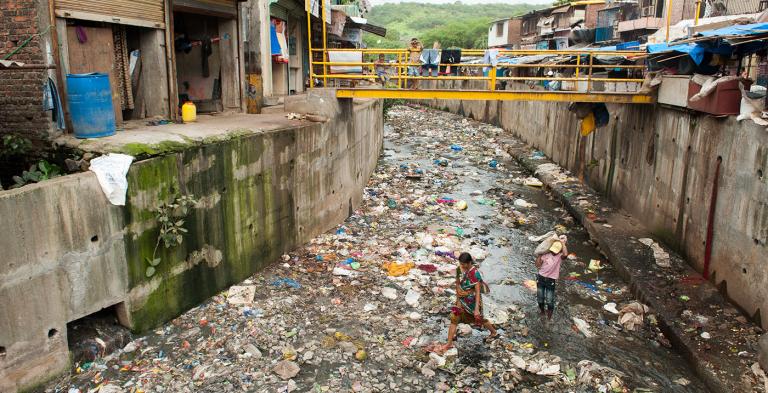 |
| In this part of the slums in Mumbai, India, many people live in close proximity in unhygienic surroundings—lacking facilities like toilets and proper drainage. |
Click here, to read more about this article.
Click here, to read more blogs on Patheos from Gospel for Asia.


Comments
Post a Comment