Gospel for Asia Reports: Fighting Malaria – A Chilling Disease (Part 2)
Wills Point, Texas – GFA Special Report (Gospel for Asia) – Discussing the continuing battle in fighting malaria worldwide via mosquito netting and medical care to combat this parasitic genius.

Malaria has a history extending back thousands of years. The legendary Greek doctor, Hippocrates (born in 460 B.C.), described periodic fevers. It was so common in the Roman Empire that one report said it may have contributed to the empire’s decline. At one time, it was also common across Europe and North America.
Malaria needs a combination of high population density, high anopheles mosquito density, and high rates of transmission from humans to mosquitos and vice versa. If any of the factors is lowered sufficiently, the parasite will eventually disappear from the area. However, unless eliminated entirely, it can be re-established if conditions revert to a combination favorable to the parasite.
The battle against the disease has raged for centuries. Scientific studies on malaria saw their first major advance in 1880, when a French army doctor working at a military hospital in Algeria observed parasites in the red blood cells of infected patients. Alphonse Lavern suggested that malaria was caused by this organism, which along with other later discoveries, earned him the Nobel Prize in 1907.
More than a century later, the battle fighting malaria continues. It is expensive. According to one report on research and development challenges in the health field, one drug costs $150–200 million and seven to 10 years to develop, one vaccine costs $600–800 million and takes 10–15 years, one diagnostic costs up to $50 million and takes three to five years, and one vector control product takes $60–65 million and 10–12 years. It projects the annual research and development need for malaria over a decade ending in 2022 will range from $5.5 billion to $8.3 billion.
Still, it is a war worth waging. Not only can severe cases cause lifelong intellectual disabilities, but its economic impact can cost billions of dollars annually in lost productivity. WHO says certain population groups are at higher risk of contracting malaria and developing serious disease: children under 5, pregnant women, patients with HIV/AIDS, non-immune immigrants, and mobile populations and travelers.
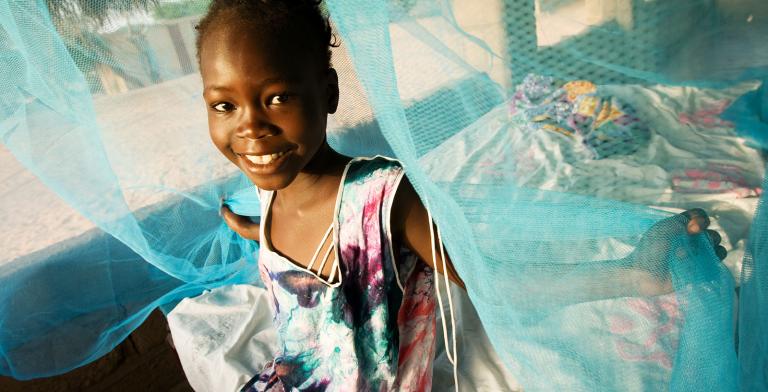 |
| Young children are often at higher risk of contracting malaria. In 2012, an estimated 207 million people suffered from malaria. About 627,000 people died, and 77 percent of those deaths were among children under the age of 5. (Photo credit Nothing But Nets) |
To date, vaccines have been lacking, but WHO hopes Mosquirix™ will prove to be a game changer. It will be administered to at least 360,000 children in areas of Ghana, Kenya and Malawi, with some regions selected for participation to serve as comparison groups to areas where the vaccine will not be available initially.
Developed by the PATH Malaria Vaccine Initiative and GlaxoSmithKline with support from the Gates Foundation, Mosquirix™ was engineered with genes from the outer protein of a malaria parasite, a portion of a hepatitis B virus, and a chemical component to boost immunity. The vaccine works to prevent infection by blocking the parasite from infecting the liver.
Although WHO has yet to make a policy recommendation for large-scale distribution beyond the pilot program, it saw some encouraging—though limited—results in a five-year-long trial (phase three of the program).
“In its ability to adapt and survive, the malaria parasite is a genius. It’s smarter than we are.”
The trial, which concluded in 2014, enrolled approximately 15,000 infants and children in seven sub-Saharan nations. Among participants who received four doses, the vaccine prevented approximately four in 10 cases of malaria (39 percent) over four years of follow-up and just over three in 10 cases of severe malaria (32 percent). Significant reductions were seen in overall hospital admissions and those for malaria and severe malaria.
It will be evaluated for use as a complementary tool, along with the preventive, diagnostic and treatment measures WHO recommends, such as indoor residual spraying with insecticides and the use of anti-malarial medicines.
Click here, to read more about this article.
Click here, to read more blogs on Patheos from Gospel for Asia.


Comments
Post a Comment