Since 1993, I Have Learned to Observe Good Friday on My Knees
Holding the Broken Body of Christ, by Karen Burton Mains
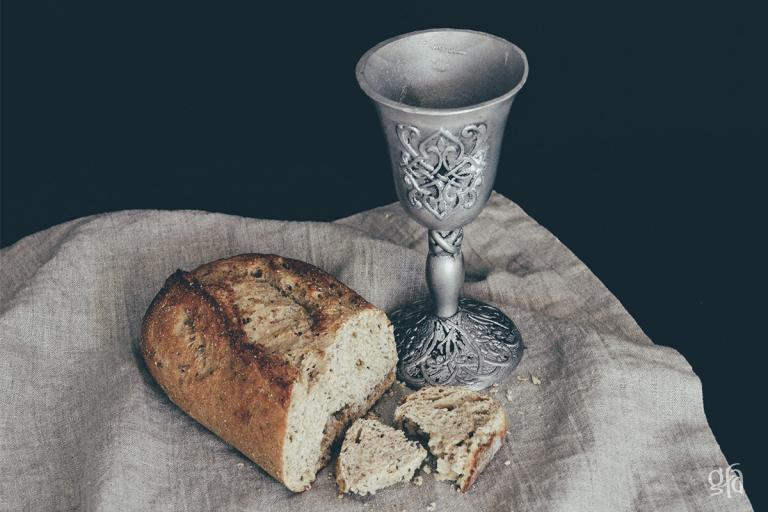
On Good Friday, 1993, around noon, I slipped into the chapel of the nearby Episcopal church where I prayed weekly for an hour or so and was surprised by something I saw. Someone had positioned a low table before the altar. On it was set a linen cloth, a small crucifix, a pottery chalice filled with wine, and an earthenware plate holding Communion wafers.
A woman bustled in the nearby sacristy.
I called out to her, “What a wonderful aid to prayer!”
Often when my mind is wandering, it helps to have some token on which to fix my eyes. Postcards sent by friends are tucked in my desk organizer, a fixed point of beauty from which to build a center for concentration.
“Did you arrange this?” I asked.
Still finishing her tasks, she paused, calling back that the Communion elements were brought from the previous evening’s Maundy Thursday service as a reminder to keep vigil over the broken body of Christ. Then, her work completed, she left me to the silence.
At several points in our lives, my husband, David Mains, and I found ourselves between churches. For six years we attended a black suburban congregation, and before that, we became members at an Episcopal church in the nearby town west of where we live. Since nearly 25 percent of the radio audience of the media ministry my husband headed—broadcasting some 500 times a day, some six days a week—were from liturgical churches (and we knew nothing about liturgy or the Episcopal church), we decided that we needed to expose ourselves in some way to these branches of Christendom.
The rector (pastor) of a nearby Episcopal church was evangelical and an excellent biblical communicator who welcomed our attendance and our participation. He was also an attentive liturgical coach for those of us who had not before been exposed to living by the church calendar, for instance, or with no sacramental understanding of the Eucharistic service. We became part of a small group with him—all of us involved in ministry in some way. So I became exposed to regular healing services and the anointing with oil, to personal confession with a spiritual advisor, to the three-year cycle of Scripture readings called the Lectionary and to the services of feasting and fasting and saints’ days and high holy days included in the Book of Common Prayer. I learned that the Episcopal church, or the Anglican church worldwide, was predominately evangelical and black.
In time, I became moved by the thought that the Sunday liturgy I had experienced that very week also had participants in time zones after time zones after time zones who, because of the uniformity of The Book of Common Prayer, had read the same words and prayers as had I.
Click here, to read more about this article.
Click here, to read more blogs on Patheos from Gospel for Asia.


Comments
Post a Comment