How Malaria Spreads and Kills and How to Help

Is there anything in the world more precious than a baby who’s safe and sound in dreamland? Parents do everything they can to protect their children from harm. Unfortunately, some of the most dangerous risks are unavoidable without help. Many exist just because of where a family happens to live.
Malaria is one such risk, and it has no respect for the age, fragility or innocence of a person.
Malaria is no ordinary disease. You’ve heard of it, almost certainly. You probably have a general idea about how it spreads and in which parts of the world it tends to thrive. But do you know what really happens when a person is infected? And are you aware that the world’s first malaria vaccine has only recently entered testing in the field?
It’s an age-old problem that still needs a definitive solution.
How old? According to the Journal of Infectious Disease, Hippocrates, widely regarded as the father of medicine, discussed a disease that many believe was malaria. Modern scientists have also discovered infected mosquitoes preserved in primitive samples of Baltic amber.
It seems to have nearly always been around. But stopping it has been proven to be an insurmountable task. Malaria-preventive medications exist, but a vaccine has been a long and laborious journey. While mosquito netting seems like an ordinary thing, it has the power to save lives by preventing mosquito bites. Netting isn’t new or fancy, but it’s on the front lines of defense, especially in parts of the world where medical care is more difficult to find.
Galatians 6:2 tells us, “Bear one another’s burdens, and so fulfill the law of Christ.” Through the combined efforts of devoted missionaries, the World Health Organization (WHO) and several other globally recognizable organizations and foundations hard at work, we can protect against this terrible disease and cure it when it happens.
Gospel for Asia is involved in the good fight to protect people from malaria. GFA has distributed hundreds of thousands of mosquito nets to people throughout South Asia who could die without them. In 2017 alone, GFA distributed over 300,000 mosquito nets.
What Exactly is Malaria?
Malaria isn’t a bacterial or viral infection; it’s a tiny parasite called plasmodium, which has five known types, according to the Centers for Disease Control (CDC).
- Plasmodium vivax
- malariae
- ovale
- falciparum
- knowlesi
Of these, P. vivax and P. falciparum are the most common. Of the two, P falciparum is the deadliest form. It’s also the most common in sub-Saharan Africa. P. knowlesi often infects primates, but it can also infect humans, specifically people living and traveling in Southeast Asia.
Each type of malaria has its own nature, but all infections have a similar course. First, they travel to the liver of the infected person, where they pause and multiply. Then they infect the red blood cells, where they multiply and spread.
Depending on the age and health of the infected person, symptoms emerge between one and two weeks after being infected with the parasites. The first symptoms, says WHO, are similar to a bout with the flu: fever, chills, headache and vomiting.
Fortunately, malaria is often curable. However, a cure depends on timely diagnosis, the right medication—and enough of it. Caught early, medication eliminates the parasite. Unchecked, a person infected with the parasites can die.
Without treatment, or without the correct medication for the person, malaria advances by destroying red blood cells and blocking capillaries to vital organs, which can end in organ failure and death.
Malaria preventive medications kill the parasites if they enter the body. Several such medications exist, but not every drug is right for every person. For people traveling where malaria is a problem, they offer reliable protection. But for people living where malaria is always a risk, daily medications aren’t a viable solution.
How Does the Malaria Disease Keep Spreading?
The plasmodium parasite is only transmitted by female mosquitoes of the Anopheles genus. Female Anopheles mosquitoes don’t inherently carry the parasite as part of their biological makeup, so not all of them can infect a person. However, WHO explains that all malaria-carrying mosquitoes that transmit the disease to humans are the female Anopheles.
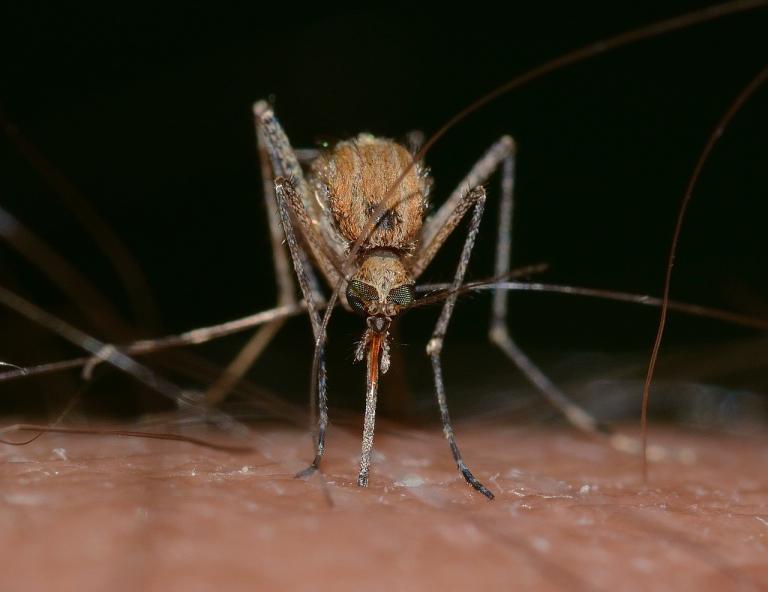
Anyone who welts up and itches practically at the thought of a mosquito knows these insects are nearly always hungry. They bite humans to find a blood meal, which helps them nourish their eggs. When the right mosquito takes a blood meal from a person with malaria, the parasite enters the insect’s body, where it reproduces. The cycle for that mosquito has then begun.
But mosquitoes don’t bite in the truest sense of the word, and they also do more than extract blood. Infection begins with an injection.
The familiar sting comes from the proboscis, which is the scientific name for a mosquito’s long, multi-prong, needle-like nose. The bite is really a stab, which allows the mosquito to withdraw blood and inject its own saliva. Plasmodium parasites thrive in the saliva of infected female Anopheles mosquitoes.
Once the mosquito extracts malaria parasites from its victim, the parasites reproduce inside the insect’s body. The next time the mosquito needs a blood meal, the stab injects parasites into its new victim while it extracts blood. The more people it bites, the more people it infects, and the more people who carry the malaria parasite to infect more and more female Anopheles mosquitoes.
It’s a vicious, unrelenting cycle.
Click here, to read more about this article.
Click here, to read more blogs on Patheos from Gospel for Asia.


Comments
Post a Comment