2.4 Billion People Still Have No Toilet Reports Gospel for Asia
World Toilet Day, established for November 19th by the UN in 2013, coincides with the 2001 creation of the World Toilet Organization, an organization aimed at raising awareness about and addressing the need for toilets all around the world.
Since Gospel for Asia’s field partners started constructing toilets in 2012, we have helped provide more than 28,000 of these facilities across many Asian nations, including Nepal and India—10,512 of which were constructed in 2016 alone. It’s an exciting thing to be able to come alongside impoverished families and give them a little dignity.
On Oct. 2, 2014, Prime Minister Narendra Modi launched Swachh Bharat (Clean India), an initiative to clean India in multiple ways, including the goal of eliminating open defecation in the nation by Oct. 2, 2019—the 150th anniversary of Mahatma Gandhi’s birthday.
We are proud to be a small part of impacting families, transforming communities and enabling education (more on that later) through toilets.
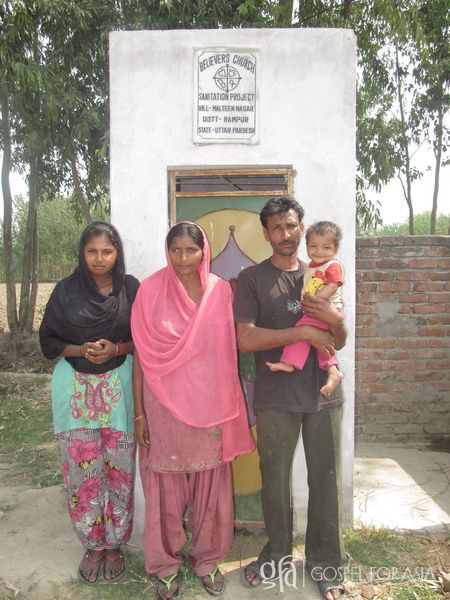
Gospel for Asia’s field partners regularly inaugurate new toilets, like they did for Mae and her family. Here’s her story.
The Testimony of a Toilet
Like many others in their village, Reuel, Mae and their family had no toilet facility and had to use the open field early in the morning. They especially struggled during the rain. Mae often felt unsafe and uneasy having to go out in the open, visible to any prying eye, but she had no other choice. Although Reuel and Mae made plans to construct a toilet of their own, they couldn’t come up with the funds to start the project.
2.4 billion Still Have No Toilet
Did you know that to this day, some 2.4 billion people worldwide—about one-third of the planet—still don’t have access to adequate sanitation facilities? Bringing that number to zero by 2030 is one of the UN’s 17 Sustainable Development Goals.
But seriously—2.4 billion people?
When I was a kid, I enjoyed our rustic camping trips. There were places we went where we had to use a trowel because there were no toilets for miles. That was an interesting novelty, part of the experience.
 |
| This is the only sanitation facility (or restroom) in this village. |
But I never had to worry about men coming and attacking me. I wasn’t concerned about finding someone else’s mess. My biggest concern was usually avoiding bug bites in awkward places and making sure I kept my clothes clean in the process.
I could handle it for a few days, but I was always thankful to have a porcelain seat once we got back home. I can’t imagine having to go outside every single day. Rain or shine, snow or wind, mosquito swarms and prickly grass.
And that’s to say nothing of the mess.
Bacteria, parasites and viruses breed rampant in areas which have been used as toilet fields for years. According to the World Health Organization, more than 1.5 billion people around the world are affected by soil-transmitted parasites due to inadequate sanitation.We’re talking worms, here.
People squat directly into rivers that others bathe in, wash in, and get their drinking water from. It’s no wonder nearly 1,000 children die from sanitation and polluted-water-related deaths every day.
A toilet is a lot more than dignity. It means safety from diseases, from attacks, from bugs and harsh weather. But toilets also impact education in ways not many people may realize.
Click here, to read more about this article.
Click here, to read more blogs on Patheos from Gospel for Asia.
Comments
Post a Comment